Aldehydes, Ketones and Carboxylic Acids — NEET UG practice

100 questions

Practice NEET UG Aldehydes, Ketones and Carboxylic Acids questions free — each with a detailed solution, graded instantly. Nothing is saved; log in to track your accuracy and build a streak.

Sample questions with solutions

Q1 · 2026

Match List I with List II:
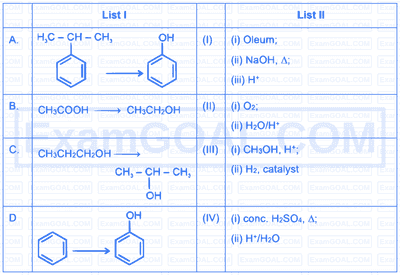
Choose the correct answer from the options given below :

  • A.

    A-II, B-III, C-I, D-IV

  • B.

    A-II, B-III, C-IV, D-I

  • C.

    A-II, B-IV, C-III, D-I

  • D.

    A-I, B-III, C-IV, D-II

Answer: B
  1. Understand the matching task. List I gives specific chemical transformations, and List II gives possible reagent sets; each reaction in List I must be paired with the reagent combination that actually brings it about.

  2. Work out one confirmed pairing as a check. Converting acetic acid into ethanol requires Fischer esterification followed by reduction:

CH3COOH(i) CH3OH,H+CH3COOCH3(ii) H2,catalystCH3CH2OH\mathrm{CH_3COOH} \xrightarrow[\text{(i) }\mathrm{CH_3OH},\,\mathrm{H^+}]{} \mathrm{CH_3COOCH_3} \xrightarrow[\text{(ii) }\mathrm{H_2},\,\text{catalyst}]{} \mathrm{CH_3CH_2OH}

This confirms reaction B pairs with reagent set III.

  1. Apply the same logic to the remaining reactions. Each of the other transformations in List I is matched to the reagent set capable of achieving exactly that structural change, using standard reactions of carboxylic acid derivatives (esterification, reduction, oxidation, and hydrolysis).

  2. Combine all pairings. Working through the full set gives A-II, B-III, C-IV, D-I.

  3. Conclusion. This complete correspondence matches option B. Hence, the answer is B.

Q2 · 2026

In a test tube containing a salt, a few drops of dilute H2SO4\mathrm{H_2SO_4} was added, which gave colourless vapours having the smell of vinegar. The vapours turned the blue litmus paper red.

Identify the correct anion from the following :

  • A.

    Sulphide, S2\mathrm{S}^{2-}

  • B.

    Sulphate, SO42\mathrm{SO_4}^{2-}

  • C.

    Acetate, CH3COO\mathrm{CH_3COO}^{-}

  • D.

    Carbonate, CO32\mathrm{CO_3}^{2-}

Answer: C
  1. Interpret the clue "smell of vinegar." Vinegar's characteristic odour comes from acetic acid, CH3COOH\mathrm{CH_3COOH}, which strongly suggests the salt contains an acetate ion.

  2. Write the reaction with dilute sulphuric acid. A stronger acid displaces the weaker volatile acetic acid from its salt:

2CH3COO+H2SO42CH3COOH+SO422\mathrm{CH_3COO^-} + \mathrm{H_2SO_4} \rightarrow 2\mathrm{CH_3COOH}\uparrow + \mathrm{SO_4}^{2-}

The released acetic acid vapour is colourless and smells of vinegar.

  1. Check the litmus test. Acetic acid is a weak acid, so its vapours turn moist blue litmus paper red, confirming acidity.

  2. Eliminate the other options. Sulphide would give a rotten-egg smell (H2S\mathrm{H_2S}), sulphate would not release any volatile smelly gas with dilute H2SO4\mathrm{H_2SO_4}, and carbonate would release odourless CO2\mathrm{CO_2} gas with no vinegar smell.

  3. Conclusion. Only the acetate ion matches both the vinegar smell and the acidic litmus test. Hence, the answer is C.

Q3 · 2026

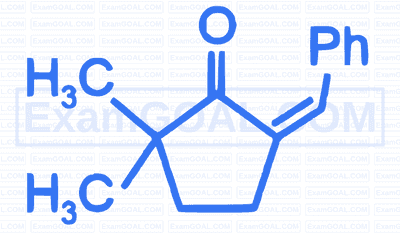
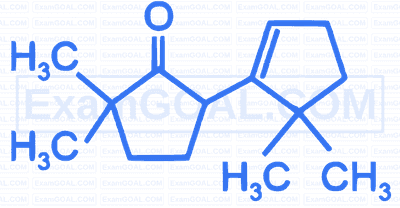
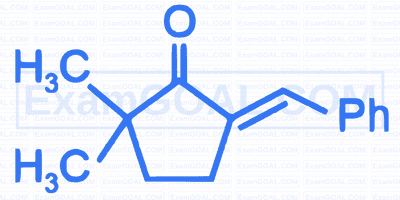
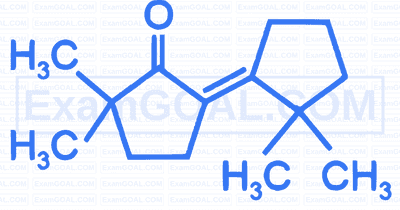
The compound that CANNOT be obtained from the aldol condensation reaction shown below, is

  • A.

  • B.

  • C.

  • D.

Answer: B
  1. Recall what an aldol condensation does. In this reaction, an enolate ion (formed from a carbonyl compound having α\alpha-hydrogens) attacks the carbonyl carbon of another carbonyl compound. So the general outcome is a β\beta-hydroxy carbonyl compound, which can further lose water to give an α,β\alpha,\beta-unsaturated carbonyl compound:
2RCH2CHOdil. NaOHRCH2CH(OH)CH(R)CHOH2ORCH2CH=C(R)CHO\mathrm{2\,RCH_2CHO} \xrightarrow{\text{dil. NaOH}} \mathrm{RCH_2CH(OH)CH(R)CHO} \xrightarrow{-\mathrm{H_2O}} \mathrm{RCH_2CH=C(R)CHO}
  1. Check which products are chemically consistent with this mechanism. Every genuine aldol/aldol-condensation product must arise from an enolate carbon of one partner bonding to the carbonyl carbon of the other partner, followed by (optionally) dehydration.

  2. Test each option against the given starting carbonyl compounds. Options A, C, and D correspond to connectivity patterns achievable by pairing the α\alpha-carbon of one reactant with the carbonyl carbon of the other, so these are valid aldol/aldol-condensation products.

  3. Identify the mismatch. Option B requires a bond connectivity that does not correspond to any valid enolate-to-carbonyl attack between the two given starting materials.

  4. Conclusion. Since option B cannot be generated by the aldol condensation mechanism from the given reactants, it is the compound that cannot be obtained. Hence, the answer is B.

Do more with a free account

  • Take it as a timed mock test
  • Build a daily streak
  • Track accuracy & progress
  • Save questions to your library