Atoms and Nuclei — NEET UG practice

132 questions

Practice NEET UG Atoms and Nuclei questions free — each with a detailed solution, graded instantly. Nothing is saved; log in to track your accuracy and build a streak.

Sample questions with solutions

Q1 · 2026

An unknown nucleus has a nuclear density of 2.29×10¹⁷ kg/m32.29 \times 10^{17} \mathrm{~kg} / \mathrm{m}^3 and mass of 19.926×1027 kg19.926 \times 10^{-27} \mathrm{~kg}. Its mass number AA is approximately:

(Take R0=1.2×10¹⁵ m,4π=12.56R_0=1.2 \times 10^{-15} \mathrm{~m}, 4 \pi=12.56 )

  • A.

    1212

  • B.

    2020

  • C.

    1616

  • D.

    1919

Answer: A
  1. Treating the nucleus as a sphere, its density is defined as mass divided by volume, and the nuclear radius follows the standard formula R=R0A1/3R=R_0A^{1/3}.
ρ=M43πR3\rho=\frac{M}{\frac{4}{3}\pi R^3}
  1. Substituting R=R0A1/3R=R_0A^{1/3} into the volume term, the A1/3A^{1/3} becomes AA after cubing, giving a direct relation between density, mass, and mass number.
43πR03A=Mρ\frac{4}{3}\pi R_0^3 A=\frac{M}{\rho}
  1. Rearranging to isolate AA and substituting all given numerical values.
A=Mρ×34πR03=19.926×1027×32.29×1017×12.56×(1.2×1015)3A=\frac{M}{\rho}\times\frac{3}{4\pi R_0^3}=\frac{19.926\times10^{-27}\times3}{2.29\times10^{17}\times12.56\times(1.2\times10^{-15})^3}
  1. Evaluating this expression numerically.
A12A\approx12

Hence, the correct answer is Option A.

Q2 · 2026

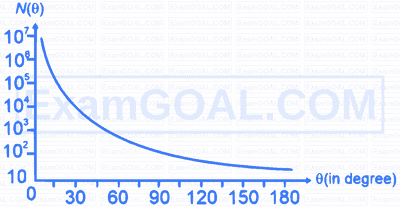
In Geiger-Marsden experiment, the number of scattered α\alpha-particles N(θ)N(\theta) is plotted as a function of scattering angle θ\theta. Which of the following options represents the correct plot?

  • A.

  • B.

  • C.

  • D.

Answer: D
  1. In Rutherford's alpha-particle scattering experiment, the number of alpha particles scattered at a given angle θ\theta depends strongly on that angle, following an inverse fourth-power law of sin(θ/2)\sin(\theta/2).
N(θ)=Ksin4(θ2)N(\theta)=\frac{K}{\sin^4\left(\dfrac{\theta}{2}\right)}
  1. This relation means that as θ\theta increases from 00^\circ, the denominator sin4(θ/2)\sin^4(\theta/2) increases rapidly, so N(θ)N(\theta) falls off very sharply — most particles are scattered at small angles, and very few at large angles.

Hence, the graph showing a steep, rapidly falling curve of N(θ)N(\theta) against θ\theta correctly represents this behaviour, matching Option D.

Q3 · 2026

In the first excited state of hydrogen atom, the energy of its electron is 3.4-3.4 eV. The radial distance of the electron from the hydrogen nucleus in this case is approximately:

(Take 1eV=1.6×10¹⁹ J,e=1.6×10¹⁹C1 \mathrm{eV}=1.6 \times 10^{-19} \mathrm{~J}, \mathrm{e}=1.6 \times 10^{-19} \mathrm{C} and 14πε0=9×10⁹ N m2/C2\frac{1}{4 \pi \varepsilon_0}=9 \times 10^9 \mathrm{~N} \mathrm{~m}^2 / \mathrm{C}^2 )

  • A.

    2.1×10⁹ m2.1 \times 10^{-9} \mathrm{~m}

  • B.

    2.1×10⁸ m2.1 \times 10^{-8} \mathrm{~m}

  • C.

    2.1×10¹⁰ m2.1 \times 10^{-10} \mathrm{~m}

  • D.

    2.1×10¹¹ m2.1 \times 10^{-11} \mathrm{~m}

Answer: C
  1. For an electron bound in a hydrogen atom, the total energy equals half of the electrostatic potential energy, but with a sign such that the magnitude of energy relates to the radius by the standard Bohr-model expression.
Kq22r=3.4 eV\frac{Kq^2}{2r}=3.4\ \text{eV}
  1. Substituting all given constants (K=9×10⁹K=9\times10^9, q=1.6×10¹⁹q=1.6\times10^{-19} C, and converting eV to joules using 1 eV=1.6×10191\ \text{eV}=1.6\times10^{-19} J) and solving for rr.
r=9×109×(1.6×1019)22×3.4×1.6×1019r=\frac{9\times10^9\times(1.6\times10^{-19})^2}{2\times3.4\times1.6\times10^{-19}}
  1. Evaluating this expression numerically gives the radius of the orbit.
r2.1176×1010 m2.1×1010 mr\approx2.1176\times10^{-10}\ \text{m}\approx2.1\times10^{-10}\ \text{m}

Hence, the correct answer is Option C.

Do more with a free account

  • Take it as a timed mock test
  • Build a daily streak
  • Track accuracy & progress
  • Save questions to your library