Capacitor — NEET UG practice

39 questions

Practice NEET UG Capacitor questions free — each with a detailed solution, graded instantly. Nothing is saved; log in to track your accuracy and build a streak.

Sample questions with solutions

Q1 · 2026

Consider two uncharged capacitors of equal capacitance 200 pF. One of them is charged by a 100 V supply and disconnected. Now this capacitor is connected to the uncharged capacitor. The amount of electrostatic energy lost in the process is:

  • A.

    0.5×10⁶ J0.5\times10^{-6}\ J

  • B.

    1.0 J1.0\ J

  • C.

    1.0×10⁶ J1.0\times10^{-6}\ J

  • D.

    0.5 J0.5\ J

Answer: A
  1. Recall the standard result for the energy lost when a charged capacitor is connected to an identical uncharged capacitor. When two capacitors C1C_1 and C2C_2 share charge, the energy lost is given by: Uloss=12C1C2C1+C2V2U_{loss}=\frac{1}{2}\cdot\frac{C_1C_2}{C_1+C_2}\cdot V^2

  2. Substitute the given values, C1=C2=200 pF=200×1012FC_1=C_2=200\ pF=200\times10^{-12}F and V=100 VV=100\ V. Uloss=12(200×200200+200)×1012×(100)2U_{loss}=\frac{1}{2}\left(\frac{200\times200}{200+200}\right)\times10^{-12}\times(100)^2

  3. Simplify the coefficient inside the bracket first. 200×200400=100\frac{200\times200}{400}=100

  4. Substitute this back and multiply through to get the final energy loss. Uloss=12×100×1012×104=12×106=0.5×10⁶ JU_{loss}=\frac{1}{2}\times100\times10^{-12}\times10^4=\frac{1}{2}\times10^{-6}=0.5\times10^{-6}\ J

Hence, the electrostatic energy lost is 0.5×10⁶ J0.5\times10^{-6}\ J, matching Option A.

Q2 · 2026

Three identical capacitors, P, Q and S, each of the capacitance CC, are connected to a battery of voltage VV, as shown in the figure. If the energy stored in the capacitor P and total energy stored in the system are UPU_P and UTU_T, respectively, then the ratio UPUT\frac{U_P}{U_T} is:

  • A.

    1/61/6

  • B.

    2/32/3

  • C.

    1/31/3

  • D.

    1/21/2

Answer: A
  1. From the figure, P and Q are connected in series with each other, and this series combination is connected in parallel with S across the battery of voltage VV. Since P and Q are identical capacitors in series, the total voltage VV splits equally between them. VP=VQ=V2V_P=V_Q=\frac{V}{2} S, being directly across the battery, gets the full voltage. VS=VV_S=V

  2. To find the energy in each capacitor, recall the formula for electrostatic energy stored in a capacitor. U=12CV2U=\frac{1}{2}CV^2

  3. Applying this formula to P (which has voltage V/2V/2 across it) gives UPU_P. UP=12C(V2)2=CV28U_P=\frac{1}{2}C\left(\frac{V}{2}\right)^2=\frac{CV^2}{8}

  4. Similarly, find UQU_Q and USU_S using the same formula with their respective voltages. UQ=12C(V2)2=CV28U_Q=\frac{1}{2}C\left(\frac{V}{2}\right)^2=\frac{CV^2}{8} US=12CV2U_S=\frac{1}{2}CV^2

  5. Total energy stored in the system is the sum of the energies of all three capacitors. UT=UP+UQ+US=CV28+CV28+CV22=3CV24U_T=U_P+U_Q+U_S=\frac{CV^2}{8}+\frac{CV^2}{8}+\frac{CV^2}{2}=\frac{3CV^2}{4}

  6. Finally, divide UPU_P by UTU_T to get the required ratio. UPUT=CV283CV24=16\frac{U_P}{U_T}=\frac{\frac{CV^2}{8}}{\frac{3CV^2}{4}}=\frac{1}{6}

Hence, the answer is Option A, 16\frac{1}{6}.

Q3 · 2026

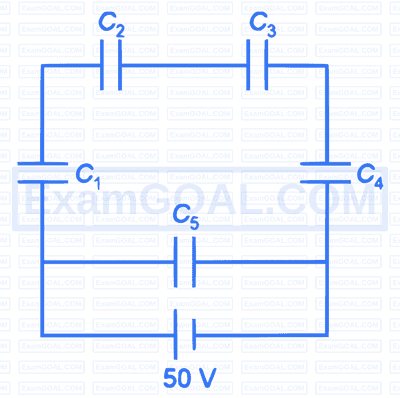
Five capacitors of capacitances C1=C2=C3=C4=10 μFC_1=C_2=C_3=C_4=10\ \mu F and C5=2.5 μFC_5=2.5\ \mu F are connected as shown, along with a battery of 50 V.

The equivalent capacitance and the charges on each capacitor respectively are:

  • A.

    5 μF5\ \mu F, 125 μC125\ \mu C on C1C_1 to C4C_4 and 25 μC25\ \mu C on C5C_5

  • B.

    5 μF5\ \mu F, 125 μC125\ \mu C on all capacitors

  • C.

    5 μF5\ \mu F, 250 μC250\ \mu C on all capacitors

  • D.

    4 μF4\ \mu F, 250 μC250\ \mu C on C1C_1 to C4C_4 and 125 μC125\ \mu C on C5C_5

Answer: B
  1. Reduce the network by combining the capacitors according to the figure — the given branches formed by C1,C2,C3,C4C_1, C_2, C_3, C_4 simplify into two identical parallel paths, each of equivalent value 2.5 μF2.5\ \mu F. Since capacitors in parallel simply add up, combine these two branches. Ceq=2.5 μF+2.5 μF=5 μFC_{eq}=2.5\ \mu F+2.5\ \mu F=5\ \mu F

  2. Use the definition of capacitance, Q=CVQ=CV, to find the total charge delivered by the battery. Given Ceq=5 μFC_{eq}=5\ \mu F and V=50 VV=50\ V, Q=CeqV=5×50=250 μCQ=C_{eq}V=5\times50=250\ \mu C

  3. Since the two branches are identical and connected in parallel, the total charge splits equally between them, and every capacitor lying along a series path within a branch carries the same charge. q1=q2=q3=q4=2502=125 μCq_1=q_2=q_3=q_4=\frac{250}{2}=125\ \mu C

  4. For C5C_5, apply Q=CVQ=CV directly using its own capacitance and the 50 V across it. q5=C5V=2.5×50=125 μCq_5=C_5V=2.5\times50=125\ \mu C

Hence, the equivalent capacitance is 5 μF5\ \mu F, and every capacitor carries a charge of 125 μC, matching Option B.

Do more with a free account

  • Take it as a timed mock test
  • Build a daily streak
  • Track accuracy & progress
  • Save questions to your library