Center of Mass and Collision — NEET UG practice

40 questions

Practice NEET UG Center of Mass and Collision questions free — each with a detailed solution, graded instantly. Nothing is saved; log in to track your accuracy and build a streak.

Sample questions with solutions

Q1 · 2026

Bob BB of mass mm at rest is hanging vertically from the ceiling via a massless string of length 10 m , as shown in the figure. Point mass AA of mass mm travelling horizontally with speed 10 ms110\ \mathrm{ms}^{-1} hits bob BB elastically. The bob BB rises hh meter after the collision. Taking the acceleration due to gravity g=10 ms2g=10\ \mathrm{ms}^{-2} and neglecting the size of the bob, the value of hh is:

  • A.

    2.5

  • B.

    8

  • C.

    7

  • D.

    5

Answer: D
  1. Notice that mass AA and bob BB have equal mass mm, and they collide elastically in one dimension. Recall the key result for an elastic collision between two equal masses: the moving mass comes to rest, and its entire velocity is transferred to the stationary mass. Hence, after the collision, bob BB moves off with the full initial speed of AA. vB=10 ms1v_B=10\ \mathrm{ms}^{-1}

  2. Since the bob is attached to a string and swings upward like a pendulum, use conservation of energy to relate its speed just after collision to the height hh it rises. Given that all kinetic energy converts into gravitational potential energy at the highest point, mgh=12mvB2mgh=\frac{1}{2}mv_B^2

  3. Cancel the mass mm from both sides and solve for hh. h=vB22gh=\frac{v_B^2}{2g}

  4. Substitute vB=10 ms1v_B=10\ \mathrm{ms}^{-1} and g=10 ms2g=10\ \mathrm{ms}^{-2}. h=(10)22×10=10020=5 mh=\frac{(10)^2}{2\times10}=\frac{100}{20}=5\ \mathrm{m}

Hence, the bob rises to a height of 5 m, matching Option D.

Q2 · 2026

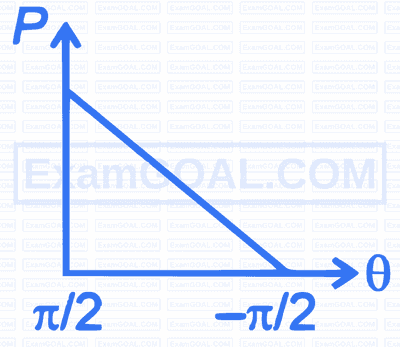
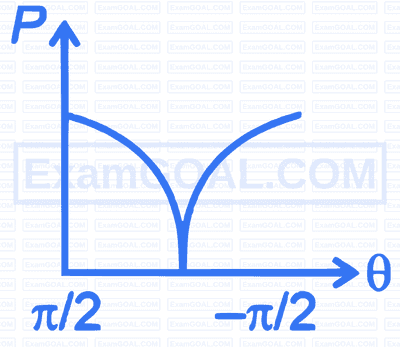
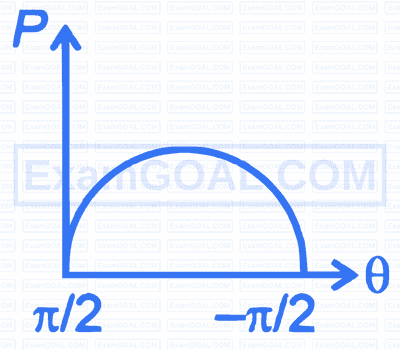
A frictionless circular wire of unit radius is fixed on the horizontal plane. Two-point particles of unit mass start moving simultaneously from point A(θ=π2)A\left(\theta=\frac{\pi}{2}\right) with identical uniform angular speeds in opposite directions, and meet again at point B(θ=π2)B\left(\theta=-\frac{\pi}{2}\right). During this time, which of the following figures schematically represent the magnitude of the total linear momentum PP of the system, as a function of θ\theta ?

  • A.

  • B.

  • C.

  • D.

Answer: D
  1. Since both particles move with identical uniform angular speeds but in opposite directions, at any instant they are located symmetrically about the vertical axis passing through the center, at angle θ\theta measured from the starting configuration.

  2. Write the velocity components of each particle. For a unit mass moving with speed vv tangent to a unit circle, the two particles' momenta have components that are mirror images of each other in the horizontal direction and identical in the vertical direction. Pnet=mvsinθi^mvcosθj^+mvsinθi^mvcosθj^\vec{P}_{net}=-mv\sin\theta\,\hat{i}-mv\cos\theta\,\hat{j}+mv\sin\theta\,\hat{i}-mv\cos\theta\,\hat{j}

  3. Notice that the horizontal (i^\hat{i}) components cancel exactly due to the symmetry, leaving only the vertical component. Pnet=2mvcosθj^\vec{P}_{net}=-2mv\cos\theta\,\hat{j}

  4. Evaluate the magnitude of this net momentum at the two endpoints of the motion, θ=π2\theta=\frac{\pi}{2} and θ=π2\theta=-\frac{\pi}{2}, where cosθ=0\cos\theta=0. At θ=±π2,Pnet=0\text{At }\theta=\pm\frac{\pi}{2},\quad \vec{P}_{net}=0

  5. Between these endpoints, the magnitude P=2mvcosθ|P|=2mv|\cos\theta| rises smoothly from zero, reaches a maximum somewhere in between, and returns to zero — a smooth bump-shaped curve, not a straight line or discontinuous jump.

Hence, the graph that matches this smooth zero-to-max-to-zero variation is shown in Option D.

Q3 · 2025

A ball of mass 0.5 kg is dropped from a height of 40 m . The ball hits the ground and rises to a height of 10 m . The impulse imparted to the ball during its collision with the ground is (Take g=9.8 m/s2g=9.8\ \mathrm{m}/\mathrm{s}^2 )

  • A.

    0

  • B.

    84 NS

  • C.

    21 NS

  • D.

    7 NS

Answer: C
  1. First find the speed of the ball just before hitting the ground, using the kinematic relation for a free fall from height h1=40 mh_1=40\ m. v1=2gh1=2×9.8×40=784=28 ms1v_1=\sqrt{2gh_1}=\sqrt{2\times9.8\times40}=\sqrt{784}=28\ \mathrm{ms}^{-1} (directed downward)

  2. Similarly, find the speed of the ball just after bouncing off the ground, since it rises to a height h2=10 mh_2=10\ m. v2=2gh2=2×9.8×10=196=14 ms1v_2=\sqrt{2gh_2}=\sqrt{2\times9.8\times10}=\sqrt{196}=14\ \mathrm{ms}^{-1} (directed upward)

  3. Recall that impulse equals the change in momentum, and taking the upward direction as positive, the downward velocity v1v_1 becomes negative. Impulse=Δp=m(v2(v1))=m(v2+v1)\text{Impulse}=\Delta p=m\left(v_2-(-v_1)\right)=m(v_2+v_1)

  4. Substitute m=0.5 kgm=0.5\ kg, v1=28 ms1v_1=28\ \mathrm{ms}^{-1}, and v2=14 ms1v_2=14\ \mathrm{ms}^{-1}. Impulse=0.5×(14+28)=0.5×42=21 Ns\text{Impulse}=0.5\times(14+28)=0.5\times42=21\ \mathrm{Ns}

Hence, the impulse imparted to the ball is 21 Ns, matching Option C.

Do more with a free account

  • Take it as a timed mock test
  • Build a daily streak
  • Track accuracy & progress
  • Save questions to your library