Geometrical Optics — NEET UG practice

83 questions

Practice NEET UG Geometrical Optics questions free — each with a detailed solution, graded instantly. Nothing is saved; log in to track your accuracy and build a streak.

Sample questions with solutions

Q1 · 2026

In a concave lens, a ray of light emanating from the object parallel to the principal axis of the lens after refraction:

  • A.

    passes through 2F2F, which is the radius of curvature of the lens.

  • B.

    appears to diverge from the first principal focus.

  • C.

    emerges parallel to the principal axis.

  • D.

    passes through the second principal focus.

Answer: B
  1. Recall how a concave lens bends parallel rays. A concave (diverging) lens spreads out any ray that travels parallel to the principal axis instead of converging it.

  2. Trace the ray backward. After refraction, the outgoing ray diverges, but if we extend this diverging ray backward on the same side as the incoming ray, all such backward extensions appear to meet at a single point on the object side of the lens.

  3. Identify this point. This point, from which the refracted ray appears to diverge, is the principal focus on the side of the incident ray.

  4. Conclude the behaviour. So the ray does not actually pass through any focus (since it diverges), it only appears to diverge from a focal point.

Hence, the correct description is that the ray appears to diverge from the first principal focus, matching option B.
Q2 · 2026

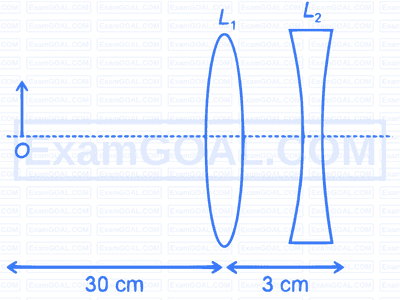
The lens combination as shown in the figure, consists of two lenses, L1L_1 and L2L_2, of the focal lengths +10+10 cm and 10-10 cm, respectively. The position of the image formed is:

  • A.

    60 cm to the right of the concave lens

  • B.

    20 cm to the left of the concave lens

  • C.

    60 cm to the left of the concave lens

  • D.

    30 cm to the right of the concave lens

Answer: C
  1. Handle each lens one at a time. In a lens combination, the image formed by the first lens acts as the object for the second lens, so we apply the lens formula twice. The lens formula is,
1v1u=1f\dfrac{1}{v} - \dfrac{1}{u} = \dfrac{1}{f}
  1. Apply it to the convex lens L1L_1. From the figure, the object distance for L1L_1 is u=30u=-30 cm and its focal length is f=+10f=+10 cm. Therefore,
1v=1f+1u=110130=230\dfrac{1}{v} = \dfrac{1}{f} + \dfrac{1}{u} = \dfrac{1}{10} - \dfrac{1}{30} = \dfrac{2}{30}

So,

v=+15 cmv = +15\text{ cm}

This means L1L_1 forms an image 1515 cm to its right.

  1. Treat this image as the object for the concave lens L2L_2. From the figure, this point lies on the far side of L2L_2, so it behaves as a virtual object with u=+12u'=+12 cm, while f=10f'=-10 cm for L2L_2. Using the lens formula again,
1v=1f+1u=110+112=160\dfrac{1}{v'} = \dfrac{1}{f'} + \dfrac{1}{u'} = -\dfrac{1}{10} + \dfrac{1}{12} = -\dfrac{1}{60}

So,

v=60 cmv' = -60\text{ cm}
  1. Interpret the sign. A negative vv' means the final image forms on the same side as the incoming light for L2L_2, i.e., to its left.

Hence, the final image is formed 60 cm to the left of the concave lens, matching option C.

Q3 · 2026

Which of the following measurements require 'index correction'?

  • A.

    Measurement of speed of sound using resonance tube

  • B.

    Measurement of resistance of a wire using meter bridge

  • C.

    Measurement of gravitational acceleration using simple pendulum

  • D.

    Measurement of focal length of lenses using optical bench

Answer: D
  1. Understand what 'index correction' means. In experiments performed on an optical bench, the tip of the pointer or the optical centre of a lens may not exactly coincide with the reading shown on the scale due to a small, fixed positioning error.

  2. Recognize where this correction is applied. This mismatch is corrected using what is called an index correction, and it specifically arises in optical bench experiments, such as finding the focal length of lenses, because the lens holder's index mark and the actual optical centre can be slightly offset.

  3. Check the other options. The resonance tube (sound speed), meter bridge (resistance), and simple pendulum (gg) experiments involve their own specific corrections (like end correction or measuring the effective length), but none of these are called 'index correction'.

Hence, the correct answer is option D.

Do more with a free account

  • Take it as a timed mock test
  • Build a daily streak
  • Track accuracy & progress
  • Save questions to your library