Moving Charges and Magnetism — NEET UG practice

80 questions

Practice NEET UG Moving Charges and Magnetism questions free — each with a detailed solution, graded instantly. Nothing is saved; log in to track your accuracy and build a streak.

Sample questions with solutions

Q1 · 2026

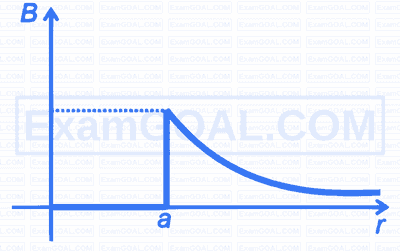
The figure given below shows a long straight solid wire of circular cross-section of radius 'aa' carrying steady current II. The current II is uniformly distributed across its cross-section. The plot which correctly represents the variation of magnetic field (B)(B) with distance (r)(r) from the axis of the conductor in the region is :

  • A.

  • B.

  • C.

  • D.

Answer: A
  1. Since the current is uniformly distributed over the cross-section, we use Ampère's circuital law, Bdl=μ0Ienc\oint \vec{B}\cdot d\vec{l} = \mu_0 I_{enc}, taking a circular Amperian loop of radius rr coaxial with the wire.

  2. For a point inside the wire (r<ar < a), only the fraction of current enclosed within radius rr contributes. Since current density is uniform, the enclosed current is Ir2a2I \cdot \dfrac{r^2}{a^2}.

Applying Ampère's law:

B(2πr)=μ0Ir2a2B(2\pi r) = \mu_0 I \frac{r^2}{a^2}

Solving for BB:

B=μ0Ir2πa2B = \frac{\mu_0 I r}{2\pi a^2}

This shows that inside the wire, BB increases linearly with rr.

  1. For a point outside the wire (r>ar > a), the entire current II is enclosed by the Amperian loop.

So,

B(2πr)=μ0IB(2\pi r) = \mu_0 I B=μ0I2πrB = \frac{\mu_0 I}{2\pi r}

This shows that outside the wire, BB decreases as 1r\dfrac{1}{r}.

  1. Combining both results: BB rises linearly from zero at the centre to a maximum at r=ar = a, and then falls off as 1r\dfrac{1}{r} for r>ar > a.

This behaviour is correctly shown in Option A.
Q2 · 2026

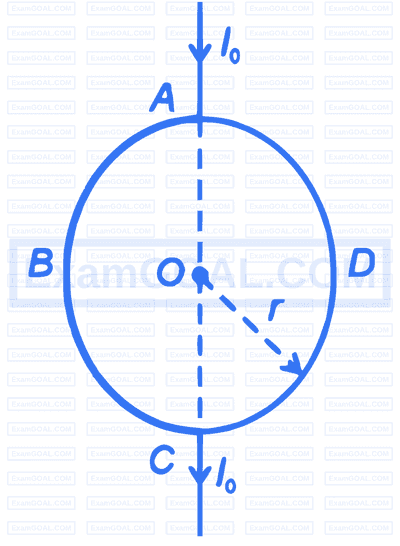
A current l0l_0 flows through a metallic circular loop of radius rr as shown in the figure. Resistance of the segment ABCABC is half that of ADCADC. Magnitude of magnetic field at the centre OO of the loop is :

  • A.

    μ0I02πr\frac{\mu_0 I_0}{2 \pi r}

  • B.

    μ0I012r\frac{\mu_0 I_0}{12 r}

  • C.

    μ0I04r\frac{\mu_0 I_0}{4 r}

  • D.

    μ0I02r\frac{\mu_0 I_0}{2 r}

Answer: B
  1. Since both arcs ABCABC and ADCADC connect the same two points AA and CC, they act like two resistors in parallel across the same potential difference, so the current in each branch is inversely proportional to its resistance.

Given RABC=R2R_{ABC} = \dfrac{R}{2} and RADC=RR_{ADC} = R, applying I1RABC=I2RADCI_1 R_{ABC} = I_2 R_{ADC}:

I1R2=I2RI_1 \cdot \frac{R}{2} = I_2 \cdot R

This simplifies to I1=2I2I_1 = 2I_2.

  1. The two branch currents must add up to the total current supplied to the loop.

So,

I1+I2=I0I_1 + I_2 = I_0

Substituting I1=2I2I_1 = 2I_2: 2I2+I2=I02I_2 + I_2 = I_0, giving I2=I03I_2 = \dfrac{I_0}{3} and I1=2I03I_1 = \dfrac{2I_0}{3}.

  1. Each semicircular arc produces a magnetic field at the centre given by B=μ0I4rB = \dfrac{\mu_0 I}{4r}, but the two arcs carry current in opposite senses around the centre, so their fields point in opposite directions.

Hence the net field is the difference of the two individual fields:

B0=μ0I14rμ0I24rB_0 = \frac{\mu_0 I_1}{4r} - \frac{\mu_0 I_2}{4r}
  1. Substituting the values of I1I_1 and I2I_2 found above:
B0=μ04r(2I03I03)=μ0I012rB_0 = \frac{\mu_0}{4r}\left(\frac{2I_0}{3} - \frac{I_0}{3}\right) = \frac{\mu_0 I_0}{12r}

Hence, the correct answer is Option B.

Q3 · 2026

Two infinitely long parallel conducting wires AA and BB carry currents II and 2I2 I, respectively, in the same direction. The wire AA has uniform mass per unit length λ\lambda and lies on an insulated floor. The wire BB is kept fixed at a height hh above the floor. The minimum magnitude of hh so that the wire AA does not rise from the floor is: [ gg is the acceleration due to gravity and μ0\mu_0 is the permeability of free space.]

  • A.

    4μ0I2πλg\frac{4 \mu_0 I^2}{\pi \lambda g}

  • B.

    μ0I22πλg\frac{\mu_0 I^2}{2 \pi \lambda g}

  • C.

    μ0I2πλg\frac{\mu_0 I^2}{\pi \lambda g}

  • D.

    2μ0I2πλg\frac{2 \mu_0 I^2}{\pi \lambda g}

Answer: C
  1. Two parallel current-carrying wires attract each other when their currents are in the same direction. This attractive force is what would try to lift wire AA off the floor.

The force per unit length between two long parallel wires separated by distance hh is:

Fl=μ0I1I22πh\frac{F}{l} = \frac{\mu_0 I_1 I_2}{2\pi h}
  1. Here I1=II_1 = I (wire AA) and I2=2II_2 = 2I (wire BB), so substituting:
Fl=μ0(I)(2I)2πh=μ0I2πh\frac{F}{l} = \frac{\mu_0 (I)(2I)}{2\pi h} = \frac{\mu_0 I^2}{\pi h}
  1. For wire AA to just stay on the floor (not lift off), this upward magnetic force per unit length must not exceed the weight per unit length of wire AA, which is λg\lambda g.

So the equilibrium condition is:

μ0I2πhλg\frac{\mu_0 I^2}{\pi h} \le \lambda g
  1. Rearranging for hh gives the minimum required height:
hμ0I2πλgh \ge \frac{\mu_0 I^2}{\pi \lambda g}

Hence, the minimum value of hh is μ0I2πλg\dfrac{\mu_0 I^2}{\pi \lambda g}, matching Option C.

Do more with a free account

  • Take it as a timed mock test
  • Build a daily streak
  • Track accuracy & progress
  • Save questions to your library