Polymers — NEET UG practice

35 questions

Practice NEET UG Polymers questions free — each with a detailed solution, graded instantly. Nothing is saved; log in to track your accuracy and build a streak.

Sample questions with solutions

Q1 · 2023

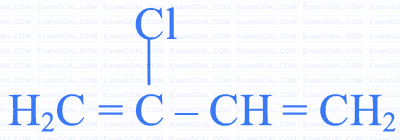
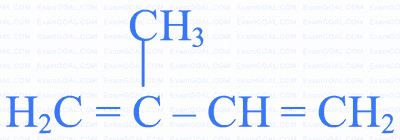
Which amongst the following molecules on polymerization produces neoprene?

  • A.

  • B.

    H2C=CHCCHH_2C=CH-C\equiv CH

  • C.

  • D.

    H2C=CHCH=CH2H_2C=CH-CH=CH_2

Answer: A
  1. Recall the monomer required to prepare neoprene. Given that neoprene is the trade name for the polymer of chloroprene (2-chloro-1,3-butadiene), the monomer must be a chlorinated diene.
CH2=CClCH=CH2 (chloroprene)CH_2=CCl-CH=CH_2 \ \text{(chloroprene)}
  1. Compare this monomer structure with the given options. Since option A depicts exactly this chloro-substituted butadiene structure, free radical addition polymerization of this monomer gives neoprene.
n(CH2=CClCH=CH2)polymerizationNeoprenen(CH_2=CCl-CH=CH_2) \xrightarrow{\text{polymerization}} \text{Neoprene}
  1. Check why the remaining options are incorrect. Option B is a vinylacetylene-type structure, option C is a different chlorinated compound, and option D is simple 1,3-butadiene (used for polybutadiene, not neoprene).

Hence, the answer is A.

Q2 · 2023

Given below are two statements:

Statement I: High density polythene is formed in the presence of catalyst triethylaluminium and titanium tetrachloride.

Statement II: High density polymers are chemically inert.

In the light of the above statements, choose the correct answer from the options given below:

  • A.

    Statement I is correct but Statement II is false.

  • B.

    Statement I is incorrect but Statement II is true.

  • C.

    Both Statement I and Statement II are true.

  • D.

    Both Statement I and Statement II are false.

Answer: C
  1. To check Statement I, recall how high density polythene (HDPE) is manufactured. Given that HDPE is made using Ziegler-Natta catalysis, the catalyst system used is a combination of triethylaluminium and titanium tetrachloride.
Al(C2H5)3+TiCl4Ziegler-Natta catalystAl(C_2H_5)_3 + TiCl_4 \rightarrow \text{Ziegler-Natta catalyst}

Therefore, Statement I is true.

  1. To check Statement II, recall the structural feature of HDPE. Since HDPE consists of linear, unbranched chains that pack closely together, it has high crystallinity and density. Hence, this close packing leaves very few reactive sites exposed, making the polymer chemically inert and resistant to attack by acids, bases, and solvents. So, Statement II is true.

  2. Since both statements are individually correct, the correct choice matches option C. Hence, the answer is C.

Q3 · 2022

Which among the following is a thermoplastic polymer?

  • A.

    Melamine polymer

  • B.

    Bakelite

  • C.

    Polythene

  • D.

    Urea-formaldehyde resin

Answer: C
  1. Recall the definition of a thermoplastic polymer. Given that thermoplastics consist of linear or slightly branched long chains held by weak intermolecular forces, they soften on heating and harden again on cooling, and this process can be repeated.

  2. Recall the definition of a thermosetting polymer. Since thermosetting polymers are heavily cross-linked or network structures, once they are moulded and set by heating, they cannot be softened again.

  3. Classify the given options using these definitions. Melamine polymer, Bakelite, and Urea-formaldehyde resin are all heavily cross-linked network polymers, so they are thermosetting. Polythene, on the other hand, is a simple linear addition polymer of ethene, so it is thermoplastic.

Hence, the answer is C.

Do more with a free account

  • Take it as a timed mock test
  • Build a daily streak
  • Track accuracy & progress
  • Save questions to your library