Q1 · 2026
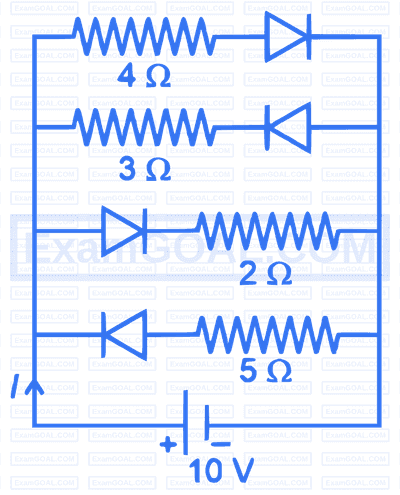
The current in the circuit shown below is: (All diodes are ideal and identical)
- A.
A
- B.
A
- C.
A
- D.
A
Answer: D
- Recall how an ideal diode behaves in a circuit.
An ideal diode offers zero resistance when forward biased (acts like a plain wire) and infinite resistance when reverse biased (acts like an open circuit, blocking all current through that branch).
- Simplify the given circuit using this rule.
By checking the polarity of the battery relative to each diode, the forward-biased diodes are replaced by simple wires (their resistance branches remain), while any reverse-biased diode branch is removed as an open circuit. Given the figure, this redraws the circuit into two parallel resistive branches of and , both connected across the same V source.
- Use Ohm's Law to find the current through each simplified branch.
Since each branch independently sees the full V:
- Add the branch currents to get the total current supplied by the battery, since the branches are in parallel.
Therefore:
Hence, the current is A, which is option D.